The Hardware Upgrade That Fixed My Software
In 2025 I went from “it’ll settle” to two surgeries: Emergency spinal decompression (C5–C7) + a hip replacement at 47. This long-form piece is about what that did to my head — the fear, the loneliness, the love, and the unexpected clarity that came with learning to walk again. Sometimes the hardware upgrade is just the beginning. The real transformation is the software you choose to run next.
FOR YOU
James
1/19/202613 min read
How two surgeries, a new hip, and a whole lot of uncertainty rewired the way I live.
I don’t just get new parts. I get a new perspective.
In nine months, I went from “it’ll settle” to two surgeries, a walking frame, and a brand-new relationship built inside hospital walls.
Somewhere between fluorescent corridors, morphine fog, and learning to walk again, it feels like a new hip quietly unlocks new parts of my brain, too, the parts responsible for humility, patience, gratitude… and the slightly annoying inner voice that asks, “So what are you doing with your life, exactly?” I think I’m signing up for an orthopaedic upgrade. Turns out it comes with an unexpected self-awareness add-on, no refunds.
And the weird thing is: the story doesn’t begin in an operating theatre.
It begins with me telling myself I’m fine.
Before 2am: The Denial Phase
In March 2025, pain starts creeping down the left side of my body. It feels muscular and nerve-y at the same time, vague enough to be confusing, loud enough to be worrying. It’s in my arm, my shoulder, my hip, my knee, my fingers, and an electric pulse running up and down the left side of my body. It doesn’t move the way it used to. Sometimes it’s excruciating. Other times it’s bearable. And that inconsistency is almost worse, because it gives me just enough hope to keep pretending it’ll disappear.
It’s like my left side is haunted, buzzing, misfiring, unpredictable.
I do what a lot of people do when something feels wrong but not headline wrong: I downplay it.
It will settle. I’ve probably just done something silly at the gym.
And when it flares, I tell myself the pain isn’t really that bad if I take my THC gummies. See? Managed. Controlled. Sorted.
But week by week, it gets worse. The pain becomes more consistent, more demanding, like my body is escalating its complaint because I’m not listening.
Until it isn’t something I can manage in the background anymore.
Because the body doesn’t negotiate, it escalates.
2am: First Night, Wrong Kind of Intimacy
It’s 2am on 28 May 2025, and I’m staying at my new boyfriend’s house for the first time. I want it to be easy, the normal kind of first sleepover energy. I don’t want to be a nuisance. I don’t want to be “a lot.” I definitely don’t want to cause a commotion.
But my body turns on me.
For about thirty minutes, I agonise in silence. Then the pain and fear make the decision for me.
There’s a deep pain, heavy and consuming, with surface-level pins and needles in my hand. Not a cute “tingle.” Static. Live wires. A force-electric pain in my left hand, forearm, and elbow.
My upper body feels dead. Not “a bit weak.” Dead. Like it isn’t listening to me anymore.
Eventually, with no other choice, I wake him up and say, simply:
“I think I need to go to the hospital. I can’t seem to move.” I am crying.
I try to sit up, and at first I can’t. The bedside lamp is on, and we lie there in the semi-dark, not really knowing what to do next, caught between “maybe it’ll pass” and “this is serious.”
(That pins-and-needles sensation never fully leaves. It’s still there today, a quiet reminder that recovery doesn’t always mean a perfect return to “before.”)
No Blue Lights, No Drama, Just Surviving
We decide on a plan in tiny steps: if I can sit up, if I can make it to the edge of the bed, we’ll call an Uber. The last thing I want is blue lights and noise at this hour.
With encouragement, I manage to get dressed and shuffle downstairs.
In the Uber, we’re almost silent. The city is calm. Too calm. Streetlights, empty roads, life continuing like nothing is happening, like the world hasn’t been notified that my nervous system is staging a coup.
Emergency: Fluorescent Reality, Three Weeks In
The waiting room is full of Sydney’s worst night shift.
A man lies on the floor with one shoe missing, high as a kite, wailing at no one in particular. We check in at the counter.
And my boyfriend of three weeks nominates himself as my next of kin.
It’s such a simple administrative act, but it lands like a commitment. In the middle of chaos and pain and fear, this man volunteers to be here.
He squeezes my hand and says, “You’re not doing this alone.”
And I believe him, even though my body doesn’t.
A triage nurse sees me, clocks the pain, and moves us somewhere quieter while we wait for a doctor. That small act, taken seriously, loosens something inside me.
The Chaos and the Unknown
The next ninety minutes feel like ninety days.
I’m not critical. I’m not bleeding out. So time stretches slowly and indifferently while people triage what matters most. Then the sentence drops: they need a neurosurgeon to assess me… and the neurosurgeon is five hours away.
I’m moved into a private room. My boyfriend returns with hot tea. I’m given morphine.
The morphine turns the volume down on the pain, and turns the volume up on the fear.
I’m scanned. X-rayed. We wait.
What’s Actually Happening in My Neck (C5–C7)
My decompression is at C5–C7, the lower part of the cervical spine, basically the “neck” section that feeds nerves into the shoulder, arm, and hand. Osteoarthritis can show up here too: discs and small joints degenerate, tissue can thicken, and bone spurs can form. Over time, the space where the nerves are meant to travel can get too tight, like a tunnel narrowing around a cable.
When those nerves are crowded or compressed, the symptoms can be weirdly intense and specific electric pain, weakness, pins and needles, and they can show up in the arm and hand because that’s exactly where those nerve pathways go. In my case, it feels like my left hand and forearm are live wires, with that surface-level pins and needles sitting on top of deeper pain.
That’s what decompression surgery is trying to fix: not a personality reset, not a miracle cure, just creating breathing room. Removing whatever is crowding the space so the nerve can settle and function again, instead of being squeezed every time I move.
It’s not about “strengthening my neck.” It’s a mechanical problem if there isn’t enough space; the nerves can’t behave normally.
The surgeon arrives just after 9:30 am. In less than five minutes, it’s agreed: I’m having emergency spinal decompression surgery on Friday morning.
It’s Wednesday.
A private room becomes available by lunchtime, and I stay there on pain relief until Friday.
I don’t rage. I don’t argue. I just accept it.
This is the situation. I’m in the right place with the right people, and everyone is doing their best.
Operation 1: The Fog (and the Quiet Love Inside It)
The next forty-eight hours blur. I’m so high on pain relief, it’s hard to remember much. It’s mostly fog.
But I know this: my boyfriend is beside me for about sixteen hours a day.
Not fixing anything. Just staying. Holding a thread of normal while my body and brain float somewhere else.
The biggest mental challenge is the unknown.
Why has this happened? What is really wrong with me? Will I get movement back? Will the pins and needles ever stop?
It’s a special kind of fear when your body becomes a question mark.
I feel helpless… but secure at the same time.
Recovery 1: “Be Gentle” (and the Limbo That Follows)
I’m discharged the day after surgery with painkillers and instructions that are both reassuring and confronting: be gentle. No exercise besides short walks for six weeks.
It isn’t a triumphant “I’m fixed” moment. It’s more like being handed my body back with a warning label: handle with care.
I’m bored. Still in pain. Not social. Not productive. Not myself. Pain shrinks your world.
And I still don’t have the full explanation. The osteoarthritis is undiagnosed. I’m rebuilding without knowing what I’m rebuilding myself for.
The Plot Twist: The Hip That Won’t Behave
About twelve weeks after spinal surgery, the hip pain gets worse, not better. Walking becomes harder, not easier.
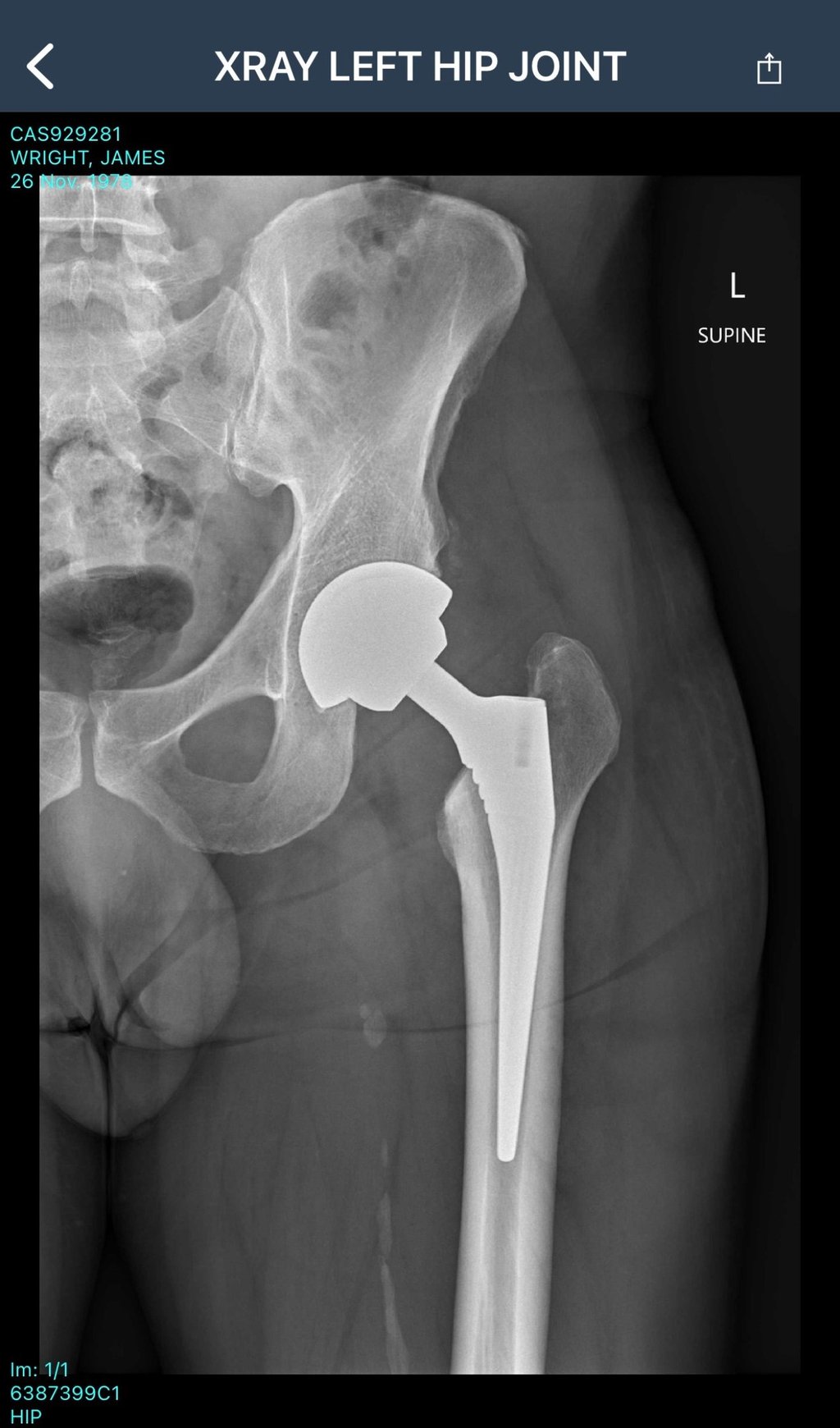
My neurosurgeon orders an X-ray of my hip.
The result isn’t vague. It isn’t “we’ll monitor it.”
It’s basically 100% certain: I need a hip replacement.
My first thought is brutally simple: I’m too young.
I’m 46 when I’m told. I turn 47 on 26 November.
My mind races through the future, grabbing the things I love and holding them hostage: cycling, kayaking, the gym.
And then the one no one talks about, but everyone thinks about privately: what about sex? Not just the act, the confidence, the spontaneity, feeling like my body is mine again.
After the initial shock, I’m almost relieved. The surgeon explains that the first few days after are painful, but the procedure is common and highly successful. For the first time in months, there’s a plan that makes sense.
What Osteoarthritis Actually Is (and Why It Hurts So Much)
Osteoarthritis sounds like one of those vague “getting older” diagnoses, but it’s actually pretty specific. It’s a type of joint wear-and-tear where the protective cartilage that helps bones glide smoothly starts breaking down. As that cushioning thins, the joint gets irritated and inflamed, movement gets stiff and painful, and the bones can start rubbing, or the joint mechanics can change in a way that makes everything worse. It’s bone on bone, and that’s not meant to happen.
In the hip, it can feel like deep pain, aching through the butt or thigh, stiffness after sitting, and a growing sense that walking is becoming work. When it gets severe enough, the “fix” isn’t more stretching or stronger painkillers; it’s replacing the joint surfaces entirely, which is exactly what a hip replacement does.
Operation 2: The Money, the Fear, the Commitment
Then comes the practical punch: my health insurance doesn’t cover it.
And honestly… what 40-year-old checks their hip-replacement coverage? The last time I review my policy, I’m still in the chapter of life where my body feels like an asset. In my early forties, I’m cycling up to 100 miles a day. A hip replacement is the farthest thing from my mind. (I have since upgraded the insurance to a pessimist-level policy.)
Now I’m staring at an estimate of about $35,000 payable at the point of surgery.
For a few days, I consider waiting twelve months upgrading insurance and letting it kick in, or putting myself into the public system.
But then I get sensible.
I can afford it, with a few sacrifices in 2026. And the priority isn’t “winning” against the system, it’s getting out of pain and back to being strong. I don’t want to spend another year bargaining with my body.
Underneath that practical choice is another truth: my boyfriend has only really known me in pain in the hospital, in recovery. Getting back to full energy feels important, not to prove anything, but to come back to life properly.
Still, on the morning of 8 December, I feel fear.
Not the obvious fear of pain. The quieter fear: what if something goes wrong? A reaction to anaesthetic. A freak complication. Something unlikely… but possible.
My mind does that strange scan people do when they’re close to uncertainty: Have I said all my I-love-yous? Have I made peace with the world?
And the honest answer is: not really.
He’s beside me until I’m wheeled away. And he’s there when I wake up, the same hand, the same steadiness. It deepens our relationship in a way words don’t.
Recovery 2: Walking Like an Old Man (and Doing It Anyway)
I wake up foggy. The pain relief is strong enough that I can’t feel much from the waist down for hours. I’m bed-bound with a catheter. I’m thirsty. I need sweet tea like it’s medicine.
Underneath the fog, I know the operation is successful. I can’t prove it yet, but I can feel the shift.
The next morning, the physio gets me out of bed to walk a few metres with a Zimmer frame.
It feels like I’m an old man. Floppy. Unsteady. Riddled with pain. Every part of me is unreliable.
And yet I do it.
Those first five metres down the corridor feel like five hundred kilometres. Then I rest. Then I do it again. Rehab isn’t one heroic moment. It’s repetition.
By day three, I can shower with railings. I can toilet alone. I can walk the corridor slowly. Two hours of physio a day, then rest, then more rest.
And still, the hardest part is the loneliness.
Not loneliness as “no one is here.” Loneliness as “this is mine to do.”
Late at night, when the ward is asleep, and I’m not allowed more pain relief, I start setting one tiny goal for the next day. Not a big life goal, a corridor goal. A shower goal. A “sit in the chair for ten minutes” goal. Something my future self can tick off and feel proud of.
Hope doesn’t arrive as a feeling. It arrives as a plan.
The thought that keeps coming back is simple, and it won’t let me off the hook:
The past nine months, two operations I’m recovering from aren’t just bad luck. They’re a warning.
A warning to make the most out of the second half of my life.
To not hold back when something is important.
To say yes when something makes me curious.
To love as hard as I can.
To show up.
To get it done.
To live it colourful and large.
Not in the “someday” way. In the now way.
Silent Courage (and a Coffee in the Sun)
If I have to name the hidden strength that carries me through, it’s courage.
But not the lion-on-the-savannah version. This is quieter. More spiritual. Almost Buddhist.
Courage as staying present when I want to escape.
Courage as accepting what is, without collapsing.
Courage as doing the next right thing when I don’t feel brave.
On 16 December, I leave the hospital on my own. I walk with my stick about 300 metres up a hill, buy a coffee, and sit in the sun.
It might not sound like much, but it feels like everything.
Then I go to the barber. I shave my head and get my beard trimmed so I look schmick for myself, for my boyfriend, for the feeling of returning to life.
It isn’t vanity. It’s agency.
Sitting there with that coffee, I feel relief.
I’m okay. I can walk. The pain in my hip is gone. For the first time in a long time, it feels like things can only get better.
Today is six weeks exactly since surgery. I’m deep in rehab: five physio appointments a week, two gentle PT sessions, and I’m walking 8,000–10,000 steps a day. I’m pushing myself not recklessly, but deliberately, because I want my strength back. I want to feel proud of my body again, not suspicious of it. Last Friday, I hit 45 minutes on the indoor cycle, and today I’m officially signed off to use the cross trainer again. Life is good. Not perfect. But better and getting better every day. I can do this.
A Reality Check (Because I’m Not a Unicorn)
Quick reality check: I’m not some inspirational unicorn. I’m one of thousands, probably millions, who deal with osteoarthritis and end up with a shiny new hip. Sure, I’m young for it to be this severe, but I’m not the main event here.
What was an event was learning to walk again.
Nothing humbles you faster than celebrating five metres, as if you’ve just won the Tour de France… and nothing strengthens you faster than realising you can rebuild from zero.
The After: What Changes When I Survive Something
When I get out the other side, I can’t unknow what that hospital room teaches me. So I start acting like I mean it.
I begin working on a startup idea in the food industry, which I’ve been talking about privately. I commit to trying again despite failures. I stop being small. I stop watering down my ambition to make other people comfortable.
I rethink my coaching practice and make it simpler to access, more comfortable for me to deliver, and more me in its language, less “marketing,” more truth.
I commit more deeply to my relationship.
I step out of my social comfort zone.
I review my finances and step up my planning.
Because when the body forces a reset, it also forces honesty. And honesty is a kind of freedom.
The Message (Without Waiting for the Crisis)
Why does it take a health shock or a life crisis for us to realise what’s really important?
It shouldn’t require something tragic or difficult for us to become fully self-aware… and yet, for most of us, it does. Pain strips away the noise. It makes it harder to avoid the truth.
Here’s what I know now: we’re all stronger than we think. Not in a motivational-poster way in the quiet, human way. The way you keep going when you’re tired, scared, uncomfortable, and bored with your own thoughts. The way you take the next step, even when you don’t feel brave.
And that kind of strength changes you.
It makes you more honest about what matters.
More willing to ask for help.
More willing to stop pretending.
More willing to love properly, not perfectly, but deliberately.
It also makes you kinder to yourself, to other people, to the version of someone who’s doing their best while falling apart.
If I’m a better coach now, it isn’t because I have better answers. It’s because I’ve lived what I ask people to do: sit with discomfort, tell the truth, take the next step, and trust that little progress adds up to a different life. I’m quicker to spot the moment someone is bargaining with their own pain. I know that voice. I used to live with it.
So here’s the invitation: don’t wait for the shock. (And no, this isn’t medical advice. If your body is waving red flags, get it checked.)
Do one thing this week, your future self will thank you for.
Say the thing. Book the thing. Start the thing. Apologise. Commit. Quit. Create. Love harder. Live larger.
Sometimes the hardware upgrade is just the beginning. The real transformation is the software you choose to run next.
P.S. There’s one part of this story I can’t wrap up neatly, because it isn’t “my strength” story — it’s his.
Loving me through this has required a kind of courage I didn’t fully understand until I watched him live it. It must be terrifying to see someone you love in pain, to sit with the quiet fear of whether they will make it through, and to carry the extra question no one says out loud: Will I cope if I have to become their carer? We even had the conversation you never imagine having six months into a relationship — whether he’d be willing to help me to the toilet if it came to that. It’s humbling. It’s raw. And it’s love in its least sexy, most sacred form.
Thankfully, it didn’t come to that, but the fact that he didn’t flinch too much still gets me. I love him harder and more deeply than I could ever have imagined — not because he rescued me, but because he stayed.
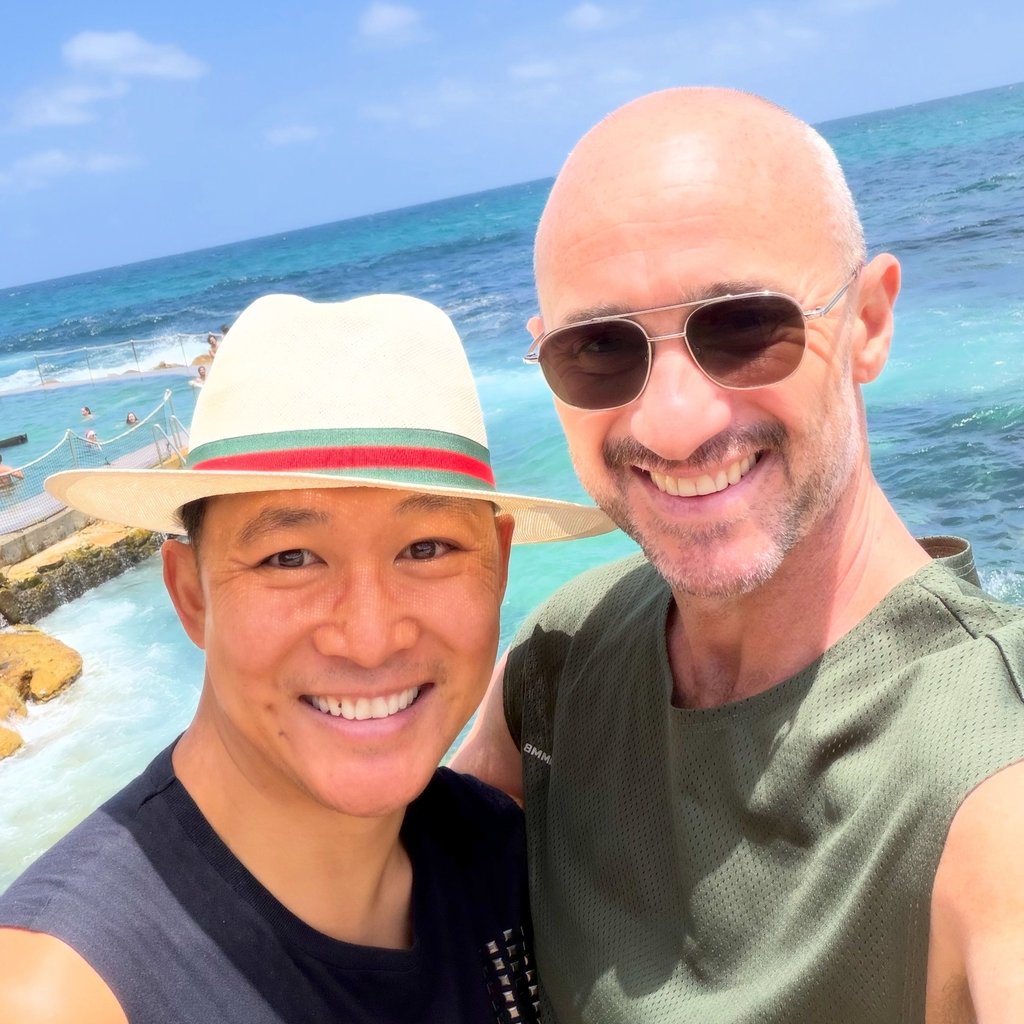
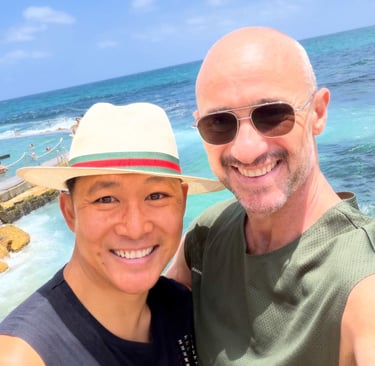
I walked down to the beach without a stick, with the Boyfriend, on Christmas Day
HiR Coaching & Consulting is a business name registered in New South Wales, Australia. ABN 53693942059






100% Money Back Guarantee
Foundations Program – Our Promise
The Foundations Program comes with a clear promise.
If, after completing Foundations, you:
do not get something positive from the experience and
do not make at least one agreed change identified in your initial 30-minute onboarding call
then you can choose one of two options:
A full refund, minus the cost of the Strengths Profile assessment, or
Continue working with me at no additional cost until you achieve a meaningful breakthrough.
This promise exists because Foundations is designed to create clarity, momentum, and real change — not just conversation.
Coaching Memberships – Flexibility, Not Guarantees
On-going coaching memberships do not come with a performance guarantee.
Instead, they are designed to be low-risk and flexible:
You can cancel at any time
There are no penalties or lock-ins
You stay because the coaching is useful — not because you’re tied to a contract.
12-Month Upfront Memberships – Pro-Rata Refunds
If you choose to pay for 12 months upfront, you’re entitled to request a pro-rata refund at any time if you decide the experience is not positive for you.
In this case:
The number of coaching sessions already attended will be deducted from the original amount paid
The remaining balance will be refunded accordingly
Important Notes
Coaching is not a done-for-you service. Results depend on your willingness to engage, reflect, and take action.
If at any point it becomes clear that the agreed effort and participation are not there, I’ll raise this directly and honestly.
If alignment can’t be restored, a refund of the unused portion of the coaching may be issued at the standard coaching rate.
Exclusions
Refunds and guarantees do not apply to the Resume & Career Upgrade Package or the Seven Days of Strengths self-guided program, due to the nature of the work and time already invested.



Terms & Conditions
Payment is immediate at the time of booking.
Prices quoted on the website are in AUD, and HiR is registered in Australia. Payments and invoices are available in AUD, USD, CND, GBP, or EURO.
All sessions are online, booked via Calendly and conducted using Google Meet unless expressly agreed otherwise. In-real-life sessions may incur additional fees for travel and incidental expenses.
Sessions can be rescheduled using the calendly booking system as required.
All Calendly sessions are booked with a 30-minute buffer so that James can extend the session without any challenges or additional fees should we continue to get the work done. After your kick-off session, the agreement with your coach on the specific results you want to achieve from your personalised program will be documented.

